Blog
Topic
All
Products and technologies
Industries
All
Education
Sports
Sustainability
Events
ESG
LED
IFPD
WonderHub
Virtual Production
Search blog
Blog
Filter
Cancel
Topic
All
Products and technologies
Industries
All
Education
Sports
Sustainability
Events
ESG
LED
IFPD
WonderHub
Virtual Production
Reset
Submit

Stadium LED displays: Applications, benefits, and real-world deployments

Sports LED displays are large-format digital screens installed across stadium environments to deliver live match content, advertising, and fan engagement programming. Today, these displays have changed what's possible both inside and outside sports venues. Market data strongly supports this trend. The global LED stadium screens market is projected to reach USD 7.41 billion by 2033, growing at a CAGR of 6.9% from 2026 to 20331. Large-format displays featuring 4K and 8K resolutions are rapidly gaining adoption across sports arenas.


This article looks at where stadium LED displays are being used, what they deliver for operators and fans, and how four European venues have put them to work.


Applications: Where can stadium LED displays be used?


  • Exterior facade and advertising screens

Large-format outdoor LED screens mounted on a stadium's exterior facade turn the building itself into a digital advertising surface — visible to pedestrians, drivers, and the surrounding area around the clock. Unlike printed banners, content updates instantly and schedules around events, match days, or commercial campaigns.

  • Scoreboards and large-format pitch-side screens

LED screens at opposite ends of the pitch display live scores, match footage, slow-motion replays, close-ups, and real-time data including substitutions, cards, and VAR decisions. In ice hockey and basketball venues, multi-sided LED display cubes (centerhung displays) are often suspended above the playing surface, solving the viewing angle problem that flat screens cannot.

  • Interior display systems: ribbon boards, perimeter LED, and video walls

360-degree ribbon displays, perimeter LED at pitch or rink level, and ultra-high-definition video walls create immersive and memorable experiences for fans in every seat. These surfaces are also among the most valuable digital stadium advertising platforms in the venue, with brand messaging visible to the entire crowd and in broadcast footage simultaneously.


  • Hospitality and concourse digital signage

LED and digital signage screens in changing rooms, reception areas, and concourses extend the broadcast experience beyond the main stands. Fans in hospitality areas stay connected to the match; operators gain additional surfaces for sponsor content and wayfinding.

From exterior facades to hospitality suites, modern sports LED displays connect every part of the stadium into a single, content-driven environment.


Benefits: What are the key benefits of stadium LED displays?


  • Immersive and memorable experiences for fans

Live footage, instant replays, player introductions, and interactive moments keep fans engaged throughout the match. Sports LED displays help venues compete with the experience of watching from home.


  • Advertising revenue and new commercial streams

Dynamic sports LED display solutions unlock advertising revenue that static signage cannot. Sponsor content, branded programming, and match day messaging can be scheduled, swapped, and priced flexibly across facade screens and interior signage. Clubs generate income from the screen itself, not just from the pitch.


  •   Operational flexibility and lower long-term costs

LED screens eliminate the cycle of printed material production and physical installation. Content updates happen in real time, with scheduling systems managing delivery across different event phases — a significant saving for venues running dozens of events per year.


  • Energy efficiency at scale

Modern stadium LED screens support more sustainable stadium operations by incorporating intelligent power distribution technology that reduces both energy consumption and environmental impact.


  • Durability for year-round outdoor use

Outdoor stadium LED screens feature high IP weatherproof ratings and aluminum chassis, enabling reliable performance across temperature extremes, humidity, and direct sunlight. Naturally, this extends the lifespan of the products, minimizing replacement costs.


For venues weighing conventional signage against LED, the combination of real-time content control and measurable advertising revenue makes LED displays the stronger long-term choice. Discover more benefits for sports venues.


Real-world deployments: Four European stadiums


Venue

Location

Screen type

Screen size

Key outcome

Belgrade Arena

Serbia

Exterior facade LED wall

228 m²

Replaced printed advertising; instant content updates

FC Hradec Králové Stadium

Czech Republic

Pitch-side scoreboards + digital signage

77 m² (outdoor)

Venue-wide content control from single system

OlympiaWorld Innsbruck

Austria

Suspended octagonal LED cube (centerhung)

96 m²

Unobstructed 360° view; increased sponsorship revenue

Piotr Wieczorek Municipal Stadium

Poland

Pitch-side scoreboards with remote control

51.61 m²

Excellent image quality, reliable performance, and efficient operation

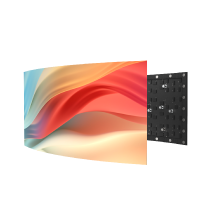
Belgrade Arena replaced a printed facade with a 228 m² curved Hikvision LED wall. The Outdoor Fixed LED Display Units feature an IP67(F)/IP66(R) weatherproof rating and customized 45° corner cuts to follow the building's curve. The arena now updates commercial advertising and game information instantly, improving both visual impact and advertising revenue.

FC Hradec Králové installed two outdoor LED screens — each 11 m wide by 7 m high — at opposite ends of the stadium, serving as both match day displays and an advertising platform. Hikvision digital signage was also integrated into VIP boxes, changing rooms, and reception areas, giving the club centralized control over content across the entire venue through a single management system.


OlympiaWorld Innsbruck replaced its outdated scoreboard with a 96 m² octagonal LED display cube suspended above the ice. Powered by Hikvision P3.9 Outdoor Fixed LED technology and built with 45° bevel cut angles for seamless multi-sided splicing, the centerhung display serves as the gives every section of the arena an unobstructed view — enhancing the spectator experience while increasing sponsorship revenue.


Piotr Wieczorek Municipal Stadium in Gliwice deployed two Hikvision P6.6 Outdoor LED Displays to meet the display demands of top-flight Polish football. Managed remotely via LED Controllers, the system allows staff to remotely schedule and control content. "With Hikvision's solution, we can deliver clear, dynamic content throughout every match while creating more engaging opportunities for sponsors and supporters alike," said Michał Kozioł, the Club's Sports and Security Manager. 

Choosing the right stadium LED display: FAQ

  • "Pixel pitch" is the distance between individual pixels in a display and determines the optimal viewing distance. The table below shows common options for stadium use:


    Pixel pitch

    Best for

    Typical application

    P3.9 (3.9 mm)

    Close-range indoor viewing

    Centerhung cubes in ice hockey/basketball arenas

    P6.6 (6.6 mm)

    Mid-range outdoor viewing

    Pitch-side scoreboards at club-level stadiums

    P10 (10 mm)

    Long-range outdoor viewing

    Large facade screens and high-capacity stadium ends

  • Outdoor permanent installations require at minimum an IP65 rating. For year-round reliability in demanding weather conditions, look for IP67(F)/IP66(R). This is the rating carried by the screens deployed at Belgrade Arena and FC Hradec Králové Stadium.


    IP rating

    Protection level

    Recommended for

    IP65

    Dust-tight; protected against  general outdoor rain

    Standard outdoor stadium use

    IP67(F)/IP66(R)

    Dust-tight; protected against immersion/powerful water jets

    Year-round operation in harsh climates

  • Standard rectangular panels suit most pitch-side and facade applications. Venues with curved architecture or multi-directional viewing requirements — such as suspended cubes for ice hockey arenas — benefit from modular systems that support custom angle splicing.

  • Stadium LED displays are typically managed through a centralized LED controller system, which allows operators to schedule, update, and distribute different content to different screens from a single interface — without needing to configure each display individually. Operators can assign specific content to specific screens (for example, match footage on pitch-side screens, sponsor ads on perimeter boards, and wayfinding on concourse displays), set automated schedules around event phases, and monitor screen status in real time.


  • Energy consumption varies by screen size and usage, but energy-saving technology can reduce consumption significantly. The P6.6 displays at Piast Gliwice Stadium cut energy use by more than 40% compared to conventional display setups(based on Hikvision internal calculating data).
no result

No matches found.

Please check for errors or try new keywords.

Find out more


At Hikvision, our sports LED display solutions are built for the full spectrum of venues, from football to ice-based events. To find out more, contact your regional Hikvision partner or visit our website for site-specific recommendations.


[1] SkyQuest (2025). LED Stadium Screens Market Size, Share, and Growth Analysis


LED Products and technologies Sports

Related links

Hikvision.com uses strictly necessary cookies and related technologies to enable the website to function. With your consent, we would also like to use cookies to observe and analyse traffic levels and other metrics / show you targeted advertising / show you advertising on the basis of your location / tailor our website's content. For more information on cookie practices please refer to our cookie policy.

Contact Us

Get a better browsing experience

You are using a web browser we don’t support. Please try one of the following options to have a better experience of our web content.